

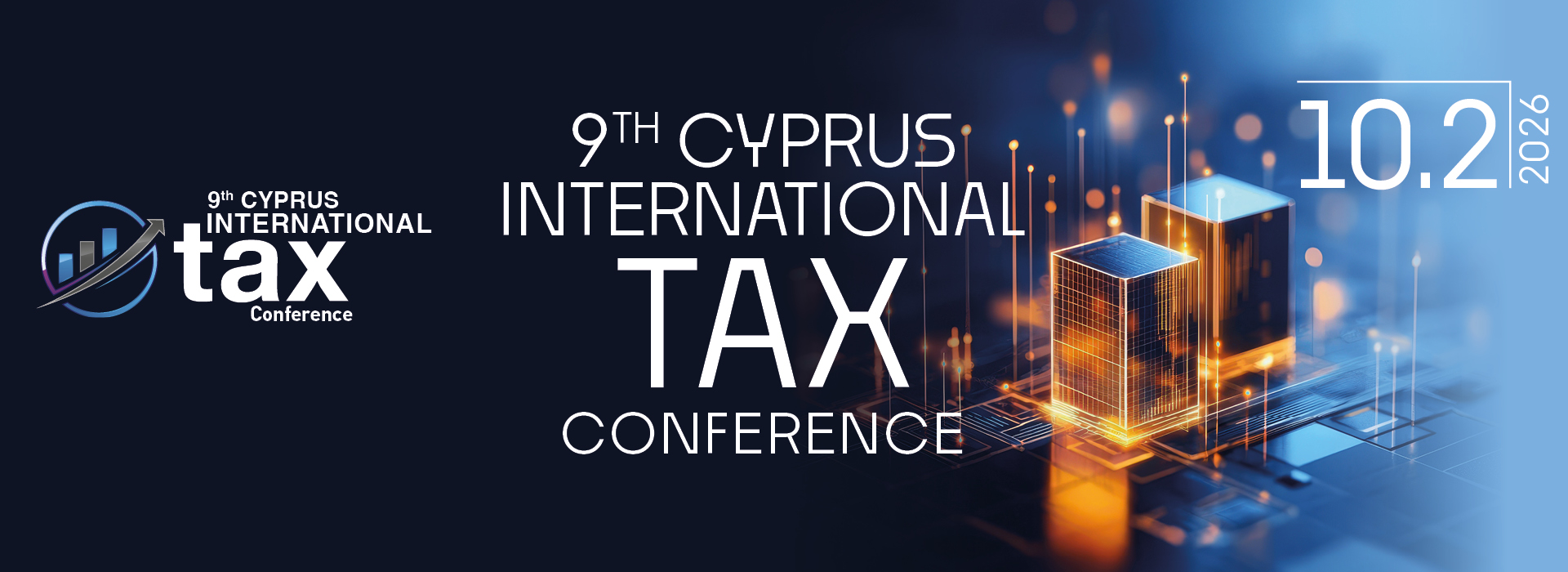
NAVIGATING REFORM, REGULATION & THE NEW GLOBAL TAX ORDER
The Cyprus International Tax Conference 2026 takes place at a pivotal moment, as Cyprus implements its most significant tax reform in over two decades and the EU accelerates major initiatives such as BEPS 2.0, DAC8, ATAD 3, ViDA, BEFIT and the Transfer Pricing Directive. Bringing together policymakers, regulators, industry associations and leading tax professionals, the conference will explore the impact of the Cyprus Tax Reform, key international tax developments and how investors and multinational groups view Cyprus in this evolving landscape. It is the country’s flagship forum for insight, clarity and strategic guidance on the future of taxation and competitiveness.
FACTS AND FIGURES
THE CONFERENCE
The global tax environment is undergoing profound transformation. Rapid regulatory developments in the EU, shifting geopolitical dynamics, digitalisation, and new technologies are reshaping how businesses operate and how tax systems function. In this landscape, Cyprus is preparing to enter a new era with the Cyprus Tax Reform 2026, the most comprehensive restructuring of its tax framework in over twenty years.
The reform aligns Cyprus with OECD BEPS 2.0, the global minimum tax, the European Union’s expanding tax architecture, and modern transparency standards. Combined with parallel EU initiatives—such as the Transfer Pricing Directive, DAC8, ATAD 3, VAT in the Digital Age (ViDA), BEFIT, and ongoing simplification efforts—the reform marks a decisive shift toward a more modern, competitive and resilient tax system.
This conference brings together policymakers, regulators, distinguished local and international experts, business leaders, tax professionals and industry associations to explore:
• The implementation and impact of the Cyprus Tax Reform
• Critical international tax developments affecting Cyprus
• How foreign investors and multinational groups view Cyprus in the new tax environment
As the country evolves its tax model, this conference aims to provide clarity, guidance and strategic insights to ensure businesses, professionals and investors are prepared for the next chapter.
It is the flagship annual event for tax professionals in Cyprus—accountants, auditors, tax advisors, lawyers, CFOs, fiduciary providers, financial institutions and regulators. A forum to gain insight, anticipate change and help shape the future of taxation for Cyprus and beyond.
AUDIENCE
The conference is addressed to professionals and more specifically senior executives from the tax and legal departments of the following:
• Accounting, Audit and Tax Firms
• Banks and other Financial Institutions
• Law Firms and Legal Consultants
• Investment Firms
• Trust Service Providers
• Wealth Management Firms
• Corporate Service Providers
• Relevant Governmental Authorities
• Local and European Regulatory Bodies
• CFOs from large corporations from all sectors of economic activity
Speakers




Key Topics
A. OPENING KEYNOTES
Introduction by the Conference Chairperson
Keynote – ICPAC President
Theme: The Role of the Tax Profession in a New Regulatory Era
• The importance of professional readiness
• Need for clarity, training and consistency
• How the profession supports reform implementation?
Keynote – Minister of Finance, Republic of Cyprus
Theme: The Cyprus Tax Reform & The EU Policy Agenda
• Strategic objectives of the Cyprus Tax Reform
• Alignment with EU priorities under Ministry leadership
• Expected impact on competitiveness & economic growth
• EU Tax Priorities to Be Advanced During the Cyprus Presidency
Keynote – Towards a Simpler, More Competitive European Tax Framework: From Fragmentation to Efficiency
In this keynote, MEP Michalis Hadjipantela presents his vision for a simpler, fairer and more competitive European tax system. Building on his landmark European Parliament initiative, he highlights how reducing fragmentation, cutting red tape and modernising tax procedures can empower businesses, attract investment and strengthen the Single Market. He will outline the practical steps Europe must take—standardised systems, digital reporting, streamlined rules—to create a tax environment where companies can focus on innovation, growth and value creation, rather than bureaucracy.
Keynote – DG TAXUD (European Commission)
Theme: The EU Tax Agenda 2026–2030
• Pillar 2 and global minimum tax enforcement
• Transfer Pricing Directive
• BEFIT and harmonisation efforts
• ATAD 3 (Unshell)
• VAT in the Digital Age
• The EU’s expectations for Member States like Cyprus
B. Cyprus Tax Reform 2026 – From Policy Design to Practical Implementation
This session explores the Cyprus Tax Reform from every angle — policy design, legislative architecture, professional interpretation, and practical business impact. Bringing together members of the official Advisory Committee, ICPAC’s technical leadership, and senior tax experts from major firms, the discussion provides a 360-degree view of how the reform will function in the real world. It addresses the structure of the new tax framework, implementation challenges, compliance expectations, system readiness, and how the reform reshapes the future of advisory services and business competitiveness in Cyprus.
Key Discussion Points
• Overall architecture of the reform: direct taxation, indirect taxation, incentives and anti-avoidance provisions
• Policy goals and alignment with OECD, EU and international tax rules
• The impact on business: Local & International
• Does this reform make Cyprus more competitive/attractive as an International Business Center?
• Transitional challenges and practical implementation issues for businesses and professionals
• Interpretative questions, grey areas and the need for clear guidance from authorities
• Tax compliance, documentation and audit expectations under the new regime
• VAT implications, digital reporting requirements and operational readiness
• Impact on business structures: holding, IP, financing, investment and operational models
• Substance and governance expectations for Cyprus-based entities
• Readiness of tax departments, ERP systems and internal processes
• Market sentiment from multinational clients and international investors
• How workloads, advisory models and the tax profession will evolve post-reform
• Long-term implications for Cyprus’ competitiveness and attractiveness as a business hub
C. Cyprus’ Competitiveness and Business Environment After the Tax Reform
This session examines how the Cyprus Tax Reform reshapes the country’s business environment, competitiveness and investment appeal. It brings together business associations, foreign investor representatives, and senior executives from both Cypriot and international companies to provide a comprehensive view of the reform’s real-world impact. The discussion highlights how different sectors experience the new framework, how foreign investors interpret the changes, what challenges companies face during transition, and what additional policy measures could enhance Cyprus’ position as a leading business and investment destination.
Key Discussion Points
• Overall impact of the tax reform on Cyprus’ competitiveness and business attractiveness
• How foreign investors and multinational groups perceive the new framework
• Sector-specific implications: technology, finance, shipping, real estate, services and professional sectors
• Administrative simplification, digitalisation and the ease of doing business
• Additional reforms and state support needed to strengthen Cyprus’ competitive edge
• How local and international companies are adapting internally: processes, systems and governance
• Effects on investment decisions, hiring, budgeting, expansion and long-term planning
• Real-life company restructuring and operational adjustments triggered by the reform
• Expectations businesses have from the Ministry of Finance, Tax Department and policymakers
• How the reform influences investor confidence and Cyprus’ ability to attract new projects, HQs and talent?
• The evolving relationship between business, regulators and tax advisors in the new environment
D. INTERNATIONAL TAX ISSUES
Pillar 2 in the Trump Era – U.S.–EU–Global Dynamics
A forward-looking analysis of how U.S. tax policy under a renewed Trump administration interacts with OECD Pillar 2, EU initiatives and global tax coordination. The session will explore the implications for European and Cyprus-based multinationals, the risk of transatlantic tax tensions, and the broader impact on competitiveness and investment flows.
• Shifts in U.S. tax policy under a second Trump administration
• Implications for EU multinationals and Cyprus-based groups
• Competitiveness impact of Pillar 2 in a diverging U.S.–EU landscape
• Risks related to Digital Services Taxes (DST) and transatlantic tensions
• Effects on cross-border investment, supply chains and group structures
E. TECHNOLOGY & EMERGING REGULATION
AI and Tax
An analysis on how artificial intelligence is transforming the tax function—from automation and analytics to compliance and advisory work—along with the new governance, data quality and ethical frameworks required for responsible adoption.
• Automation of tax workflows and repetitive processes
• AI-powered compliance tools, analytics and advisory capabilities
• Governance, data integrity and ethical considerations in AI deployment
• Skills, competencies and mindset required for the future tax advisor
DAC8 – Crypto-Asset Reporting
An overview of the EU’s DAC8 framework and its implications for crypto-asset reporting, transparency and regulation. The session will examine operational and compliance impacts for financial institutions, fintechs, exchanges and the broader digital asset ecosystem in Cyprus.
• New EU reporting obligations for crypto-asset service providers
• Integration with AML/KYC and existing reporting frameworks
• Effects on fintechs, exchanges, investment firms and custodians
• Implications for Cyprus’ positioning as a tech-friendly jurisdiction
Key Topics
A. OPENING KEYNOTES
Introduction by the Conference Chairperson
Keynote – ICPAC President
Theme: The Role of the Tax Profession in a New Regulatory Era
• The importance of professional readiness
• Need for clarity, training and consistency
• How the profession supports reform implementation?
Keynote – Minister of Finance, Republic of Cyprus
Theme: The Cyprus Tax Reform & The EU Policy Agenda
• Strategic objectives of the Cyprus Tax Reform
• Alignment with EU priorities under Ministry leadership
• Expected impact on competitiveness & economic growth
• EU Tax Priorities to Be Advanced During the Cyprus Presidency
Keynote – Towards a Simpler, More Competitive European Tax Framework: From Fragmentation to Efficiency
In this keynote, MEP Michalis Hadjipantela presents his vision for a simpler, fairer and more competitive European tax system. Building on his landmark European Parliament initiative, he highlights how reducing fragmentation, cutting red tape and modernising tax procedures can empower businesses, attract investment and strengthen the Single Market. He will outline the practical steps Europe must take—standardised systems, digital reporting, streamlined rules—to create a tax environment where companies can focus on innovation, growth and value creation, rather than bureaucracy.
Keynote – DG TAXUD (European Commission)
Theme: The EU Tax Agenda 2026–2030
• Pillar 2 and global minimum tax enforcement
• Transfer Pricing Directive
• BEFIT and harmonisation efforts
• ATAD 3 (Unshell)
• VAT in the Digital Age
• The EU’s expectations for Member States like Cyprus
B. Cyprus Tax Reform 2026 – From Policy Design to Practical Implementation
This session explores the Cyprus Tax Reform from every angle — policy design, legislative architecture, professional interpretation, and practical business impact. Bringing together members of the official Advisory Committee, ICPAC’s technical leadership, and senior tax experts from major firms, the discussion provides a 360-degree view of how the reform will function in the real world. It addresses the structure of the new tax framework, implementation challenges, compliance expectations, system readiness, and how the reform reshapes the future of advisory services and business competitiveness in Cyprus.
Key Discussion Points
• Overall architecture of the reform: direct taxation, indirect taxation, incentives and anti-avoidance provisions
• Policy goals and alignment with OECD, EU and international tax rules
• The impact on business: Local & International
• Does this reform make Cyprus more competitive/attractive as an International Business Center?
• Transitional challenges and practical implementation issues for businesses and professionals
• Interpretative questions, grey areas and the need for clear guidance from authorities
• Tax compliance, documentation and audit expectations under the new regime
• VAT implications, digital reporting requirements and operational readiness
• Impact on business structures: holding, IP, financing, investment and operational models
• Substance and governance expectations for Cyprus-based entities
• Readiness of tax departments, ERP systems and internal processes
• Market sentiment from multinational clients and international investors
• How workloads, advisory models and the tax profession will evolve post-reform
• Long-term implications for Cyprus’ competitiveness and attractiveness as a business hub
C. Cyprus’ Competitiveness and Business Environment After the Tax Reform
This session examines how the Cyprus Tax Reform reshapes the country’s business environment, competitiveness and investment appeal. It brings together business associations, foreign investor representatives, and senior executives from both Cypriot and international companies to provide a comprehensive view of the reform’s real-world impact. The discussion highlights how different sectors experience the new framework, how foreign investors interpret the changes, what challenges companies face during transition, and what additional policy measures could enhance Cyprus’ position as a leading business and investment destination.
Key Discussion Points
• Overall impact of the tax reform on Cyprus’ competitiveness and business attractiveness
• How foreign investors and multinational groups perceive the new framework
• Sector-specific implications: technology, finance, shipping, real estate, services and professional sectors
• Administrative simplification, digitalisation and the ease of doing business
• Additional reforms and state support needed to strengthen Cyprus’ competitive edge
• How local and international companies are adapting internally: processes, systems and governance
• Effects on investment decisions, hiring, budgeting, expansion and long-term planning
• Real-life company restructuring and operational adjustments triggered by the reform
• Expectations businesses have from the Ministry of Finance, Tax Department and policymakers
• How the reform influences investor confidence and Cyprus’ ability to attract new projects, HQs and talent?
• The evolving relationship between business, regulators and tax advisors in the new environment
D. INTERNATIONAL TAX ISSUES
Pillar 2 in the Trump Era – U.S.–EU–Global Dynamics
A forward-looking analysis of how U.S. tax policy under a renewed Trump administration interacts with OECD Pillar 2, EU initiatives and global tax coordination. The session will explore the implications for European and Cyprus-based multinationals, the risk of transatlantic tax tensions, and the broader impact on competitiveness and investment flows.
• Shifts in U.S. tax policy under a second Trump administration
• Implications for EU multinationals and Cyprus-based groups
• Competitiveness impact of Pillar 2 in a diverging U.S.–EU landscape
• Risks related to Digital Services Taxes (DST) and transatlantic tensions
• Effects on cross-border investment, supply chains and group structures
E. TECHNOLOGY & EMERGING REGULATION
AI and Tax
An analysis on how artificial intelligence is transforming the tax function—from automation and analytics to compliance and advisory work—along with the new governance, data quality and ethical frameworks required for responsible adoption.
• Automation of tax workflows and repetitive processes
• AI-powered compliance tools, analytics and advisory capabilities
• Governance, data integrity and ethical considerations in AI deployment
• Skills, competencies and mindset required for the future tax advisor
DAC8 – Crypto-Asset Reporting
An overview of the EU’s DAC8 framework and its implications for crypto-asset reporting, transparency and regulation. The session will examine operational and compliance impacts for financial institutions, fintechs, exchanges and the broader digital asset ecosystem in Cyprus.
• New EU reporting obligations for crypto-asset service providers
• Integration with AML/KYC and existing reporting frameworks
• Effects on fintechs, exchanges, investment firms and custodians
• Implications for Cyprus’ positioning as a tech-friendly jurisdiction
Organiser

With the Support





Communication Sponsors